January 18, 2026 – Second Sunday after Epiphany

January 18, 2026 – Second Sunday after Epiphany

Revised Common Lectionary Readings:

Isaiah 49:1-7
Psalm 40:1-11
1 Corinthians 1:1-9
John 1:29-42

Our main job as ministers of the Gospel is to point to Jesus. Everything that we do – preaching, texts, song selection, Bible Study, outreach, etc. – is in service of that obligation. Liturgy is literally “work of the people.” Though it can be a bit hard to define, I look at it in terms of its purpose: “work of the people in coming to Jesus.

The “order of worship” – particularly in a traditional service or mass – is typically what people mean when they say “liturgy.” It gets to the point, though I think that definition is unfair in the context of a contemporary service. If it is a worship service, it is liturgical. Yes, even that service by St. Mega Man with the lasers and the fog machine that blows during the offering is liturgical. Dismissing the formal structures of traditional liturgy does not make what replaces it any less “liturgical.” It just means it is a different “context” of liturgy.

I liken the “traditional vs. contemporary” designation much like “classical vs. jazz” music. They are two dialects of the same language with all sorts of mixture, interactions, and crossover in between. (Yes, they do borrow from each other.) This is not even getting into the cultural innovations that shape and influence them. Worship and liturgy are alive with the Breath of the God who inspires both.

God did not make everyone, everything, or every place the same. He did not make everyone, everything, and every place the same as they were ten minutes ago! That’s one of the reasons it is important to understand what liturgy is and its role in the life of the church.

In an earlier entry, I referenced the Wesleyan Quadrilateral – Scripture, Reason, Tradition, and Experience. There are people better suited to explain it – and some faith traditions disagree or consider different routes – but these are essentially ways that we come to understand faith.

We can tell “a” story of Jesus in 5-10 minutes, as we do every time we come to the communion table.  It is going to be a different story than can be told in thirty minutes. Or an hour. Or a season. Or a year. Or three years. Or a lifetime. The lectionary is one way we tell the story over a three year cycle. The liturgical calendar with all the celebrations – Advent, Christmas, Epiphany, Easter, Pentecost, All Saints Day, etc. – is one way the story is told over the year. There are layers to it.
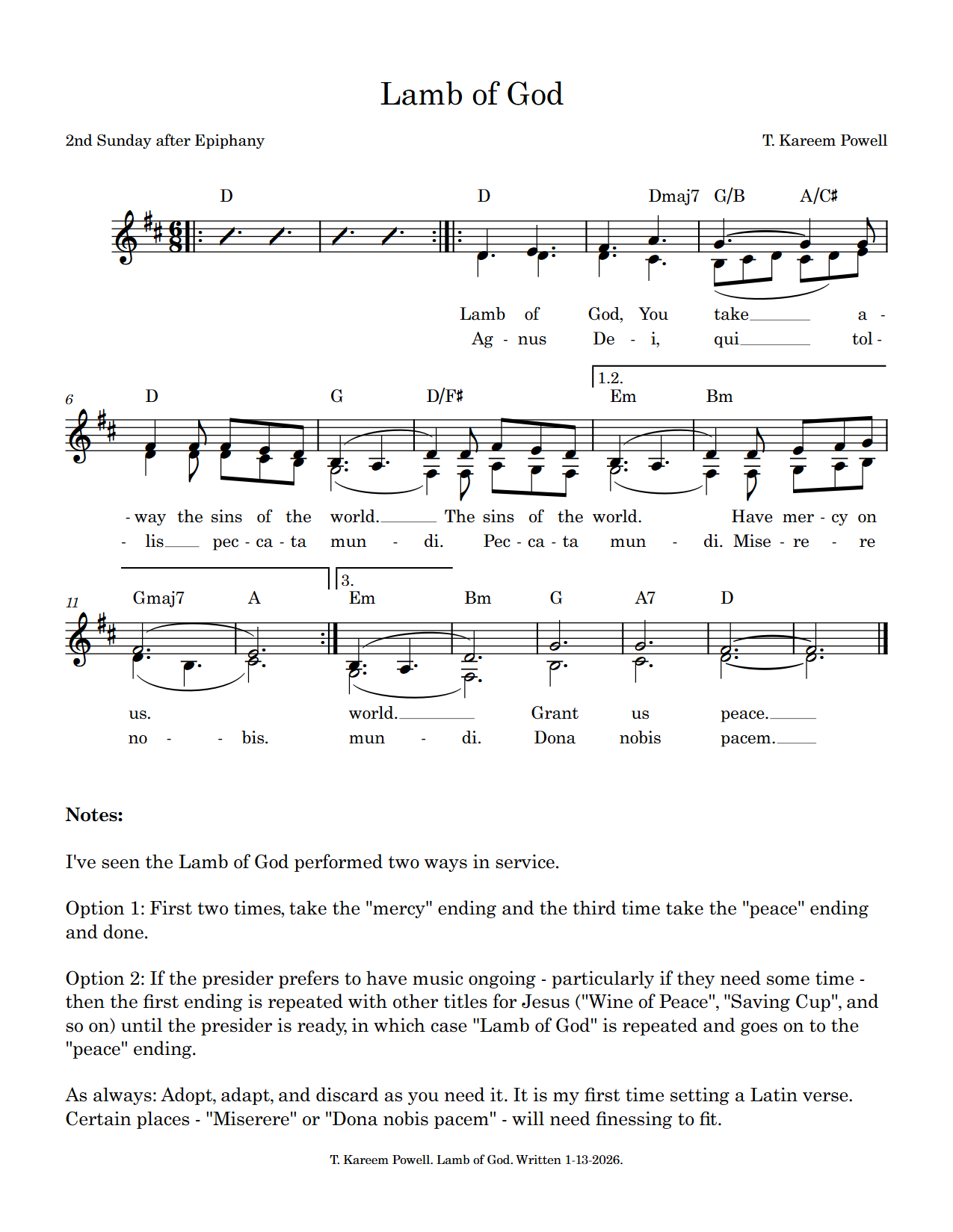
This week, I was inspired by the Gospel reading John 1:29-42. In it, John the Baptist sees Jesus and declares Him as the “Lamb of God who takes away the sin of the world.” (Yes, of course there is more.) This also happens to be the words to the Agnus Dei – aka Lamb of God – which (in a traditional service) is sung just before Communion is distributed.

Instead of a psalm response, I decided to write a Lamb of God.

As always: adopt, adapt, or discard at your leisure.
January 6, 2026 – The Feast of the Epiphany

Writer’s Note: This entry was originally posted on December 30, 2025. (I have been trying to post at least a week before the Lectionary Date.) For some reason, when my website updated to WordPress 6.9, it deleted this entry as well as the one for January 11. I did not find this out until I was about to put up my entry for January 18. It was a big mess that has set me behind on this project. Anyway… Things happen. This project is more about “reclaiming my space” – both this website and my liturgical background – than it is about getting everything out on time. It is also helpful in getting me to practice some writing and working on content. Much love and – as always – adopt, adapt, and discard at your liesure.

January 6, 2026 – The Feast of the Epiphany

Isaiah 60:1-6

Psalm 72:1-7, 10-14

Ephesians 3:1-12

Matthew 2:1-12

Even if you had not gotten to the Matthew reading yet, Isaiah and Psalm 72 should have you screaming “We Three Kings.” One thing I love about this song is that it embodies liturgy as “the work of the people.” Our faith is divinely inspired (otherwise it would not be faith). God uses a number of ways to shape it such as Scripture, tradition, reason, and experience.

Yes, I just used the Wesleyan Quadrilateral. Lutherans may feel free to direct all hate mail to sunstrikellc@gmail.com. (I’m joking! I think…)

If we relied solely on Scripture, we would never sing that song. Matthew does not say that the magi number three nor that they lead nations. The arrival at “three kings” – much less the names Caspar, Melchior, and my dude Balthazar – came about much later. Yet, these figures had such an impact on the story of Jesus and the unfolding of faith that they have been venerated as saints. These magi – regardless of how many there really are, their actual names, their royal status, or even the lands they came from – have staying power because they represent rulers – powerful people in this world – subordinating themselves to 1.) an infant, 2.) conceived (albeit by the Holy Spirit) out of wedlock, 3.) the (presumed) son of a builder, 4.) in an occupied land, and 5.) among an oppressed minority.

Baby Jesus both had ultimate power and yet at the same time no power. These wise men – who were so esteemed that Herod kissed up to them – sought Him out and bowed down to Him.

Yes. Epiphany is actually a pretty big deal, which the rest of the world already knows and yet here in the United States, we go “Oh… That’s cool.” I have more thoughts, but I’ll save those for another day.

To be clear, Epiphany is not just about the Wise Men. It is about the revelation of Jesus as the Christ: the Wise Men, Jesus’s Baptism,  and the miracle of the Wedding at Cana. Ask your pastor about those; this article is already getting long!

There are a number of liturgical possibilities in these readings. Isaiah screams to me “Call to Worship.”

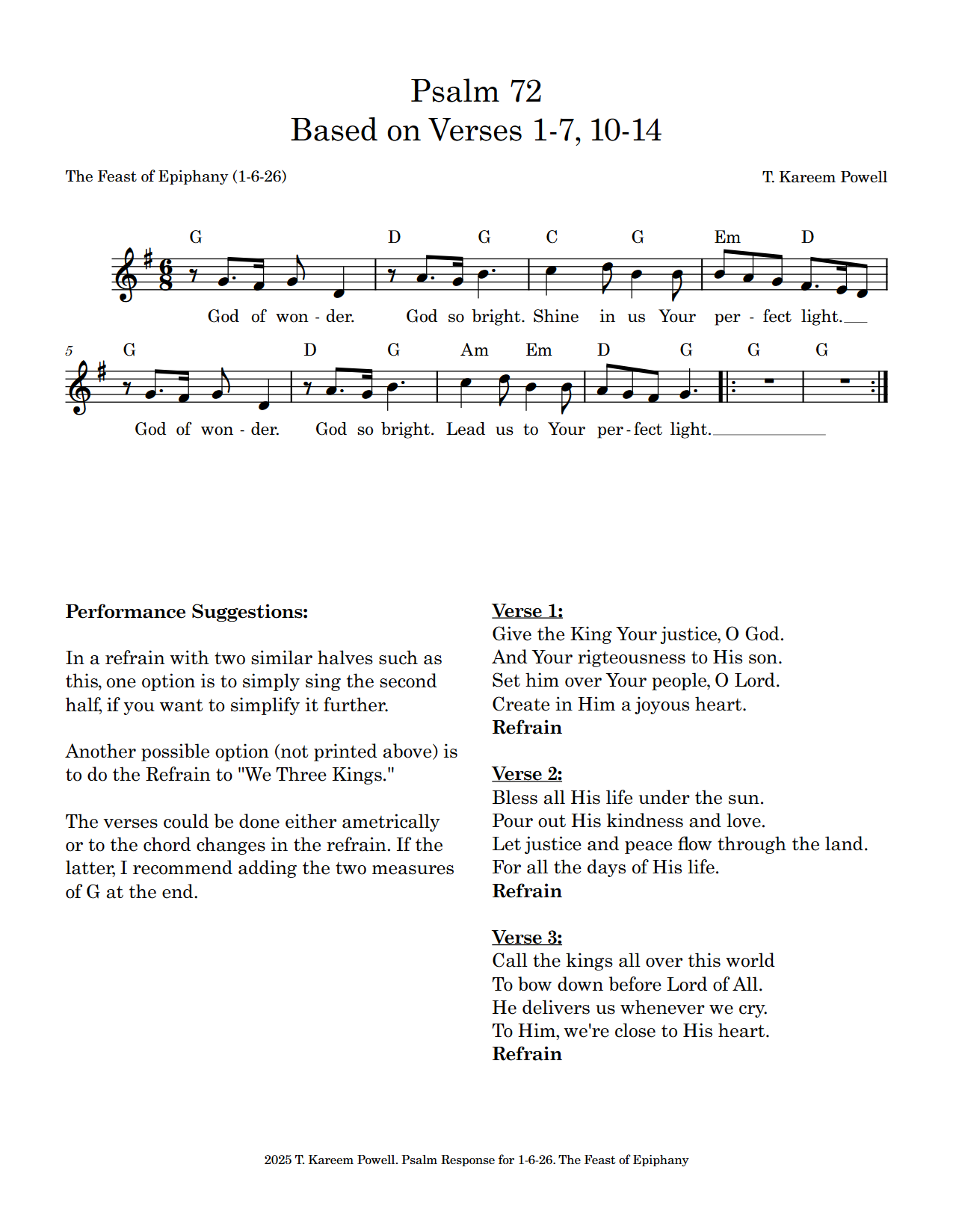
One possibility for the Psalm Response is to simply take the refrain from “We Three Kings.” (“Star of wonder, star of light…”) People generally already know it and it points to the Lord. The refrain that I am presenting is definitely inspired by “We Three Kings.”The purpose of liturgy – and anything we do – is to point in some way to the Holy Trinity. The Three Kings of Christian tradition do not strictly adhere to Scripture, but we cannot deny that they point to Jesus. They sought Him out. They brought offerings to Him. They bowed down to Him. They recognized Him as Lord. We as the Church are supposed to do all those very things.

Happy Epiphany!

January 11, 2026 – The Baptism of the Lord

Writer’s Note: I originally had a different version of this entry. For some reason, when my website updated to WordPress 6.9, this particular post (and my post on Epiphany) got wiped out. To add to it, I had previously written my blog entries on Microsoft Word and then copy + paste; this time I did not! So, this is a brand new version written from scratch except for what I copied over from the Facebook excerpt. (It wasn’t in the “Trash” bin. Trust me; first place I looked.) Well… Here goes it!

In earlier entries, I had mentioned reclaiming my “space”, which includes this website and associated social media profiles. Beyond that, I am also “reclaiming” my liturgical background. You can read more about it here. As I work my way through the Revised Common Lectionary, I am challenging myself to not only put my thoughts on it but to write out “something” liturgical/musical.

The readings for January 11, 2026 set up the Baptism of the Lord.

Isaiah 42:1-9
Psalm 29
Acts 10:34-43
Matthew 3:13-17

These four readings share some strong thematic ties and images. As I said in the first version of the entry (that got wiped out by WordPress 6.9) “This a masterful display of scriptural juxtaposition. Can this picture possibly be more developed?” Isaiah lays out from God’s perspective what pleases Him in what would be His servant. Psalm 29 talks about the glory of the Lord and makes repeated mention of His voice. 29:10 speaks particularly about being “enthroned above the flood.” Acts specifically mentions the incident of the Lord’s Baptism and sets it into the context of His ministry and makes the connections to His anointing and His resurrection. Matthew 3 narrates it. And what happens? Everything is tied together.

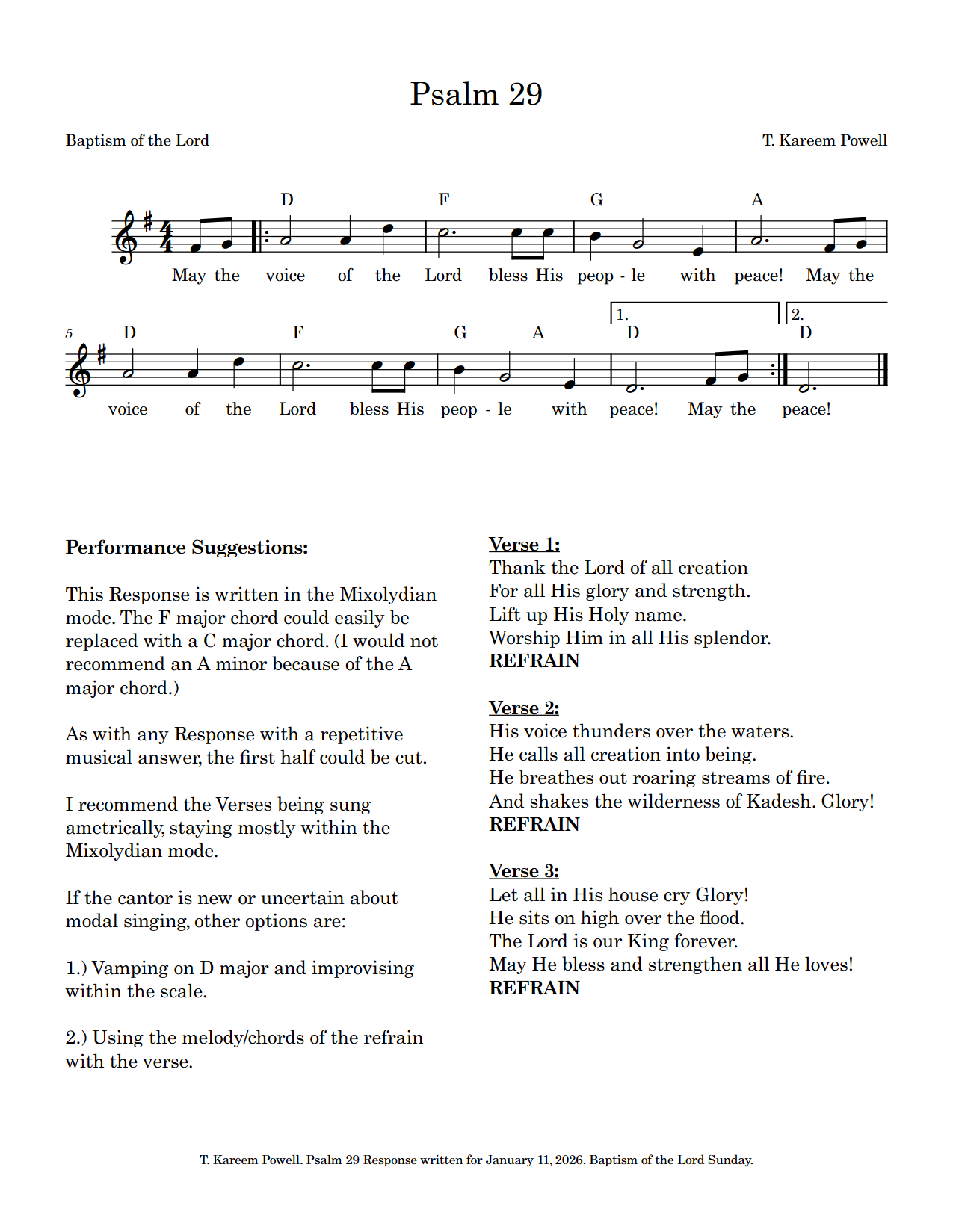
Jesus rises out of the water and God says “This is my Son with whom I am well pleased.” God is pleased in His servant. God’s voice comes out over the water, “enthroning His Beloved Son over the flood at His feet. The anointing – The Holy Spirit – is all over Him. Beautiful.The key signature may be 1 Sharp, but rest assured that the Psalm response is not in G Major. It is in the Mixolydian mode, which you will often find in folk music, be it Appalachian or its ancestor across the ocean.

As with every entry, feel free to adopt, adapt, or discard as you wish. My own views may change as the year goes by.

January 4, 2026 – Second Sunday after Christmas

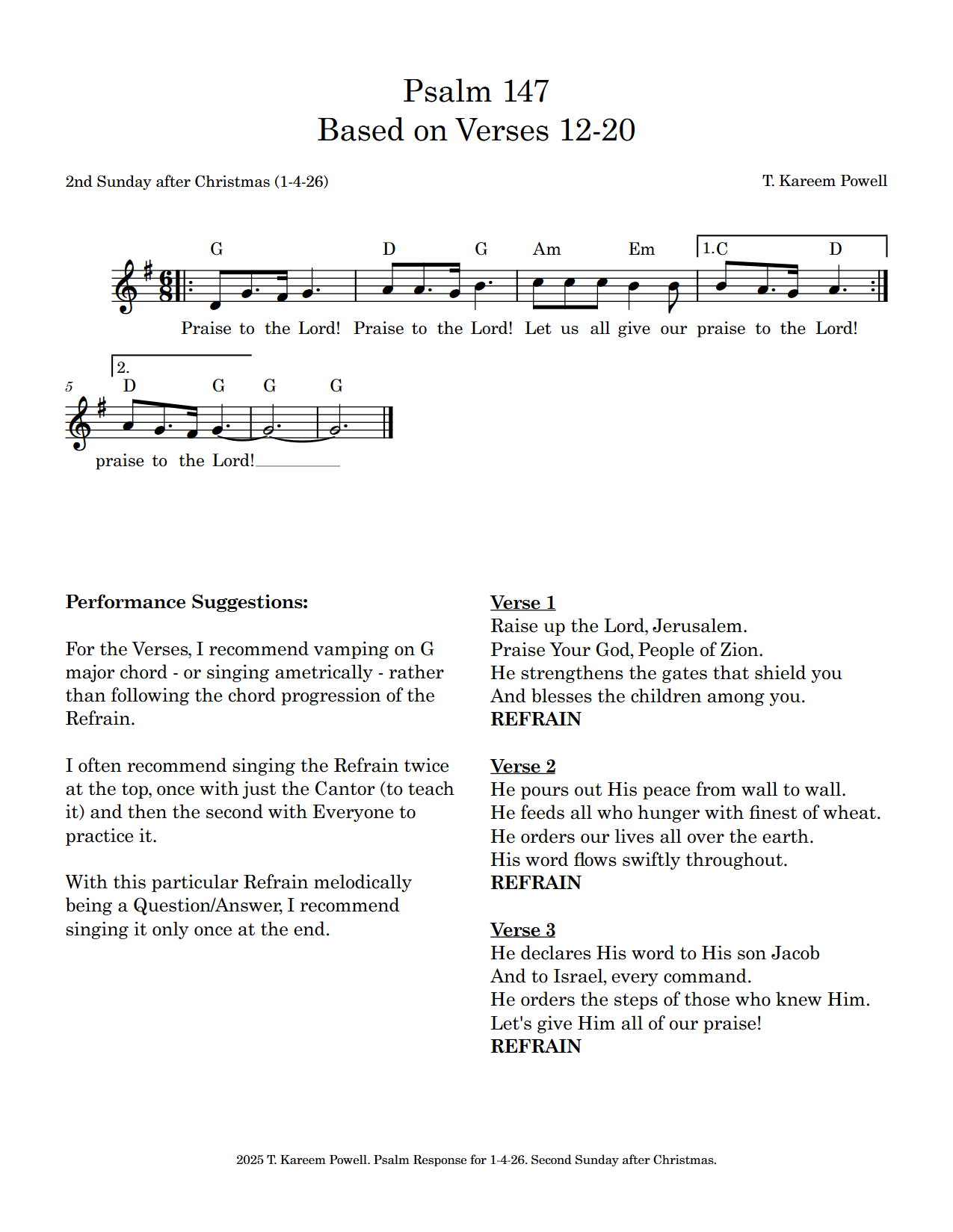
Personally, I would probably focus on the Feast of the Epiphany (which lands on Tuesday January 6) rather than proceed lockstep with the Revised Common Lectionary (RCL).

The main thing to keep in mind when considering the Liturgical Year is that it is a structured, long-form way of telling the story of Jesus. Not every celebration – major or minor – is going to land neatly on Sunday. Christmas (12/25), Epiphany (1/6), All Saints (11/1), and All Souls (11/2) are all tied to specific dates. Christmas (Eve), everyone is going to do regardless. The others all too often get glossed over (in the United States).

And I think that is a shame. I’ll mention a few thoughts about Epiphany later. Liturgy is literally “the work of the people.” It’s about Jesus AND us. Exactly what that means, I hope to expound over time. My “philosophy” – for lack of better word – is that we prioritize Jesus AND His Beloved aka US.

Now, if I was serving a faith community that had a specific dedicated celebration on Epiphany (on Tuesday), then I would have no problem sticking with the RCL in this case.

Here are the listed readings in the RCL:
Jeremiah 31:7-14 OR Sirach 24:1-12
Psalm 147: 12-20 OR Wisdom 10:15-21
Ephesians 1:3-14
John 1:(1-9), 10-18

Scanning through them, no particular themes stick out. (Praise, Adoration, Deliverance, etc. are appropriate ALL of the time.) One thing that somewhat irks me is that this is still Christmas (or Christmastide, if you will). You CANNOT cram everything on Christmas Eve. I don’t see why another Christmas reading isn’t acceptable except for the reason “Gifts have been exchanged and people are ready to move on.” Jesus Christ has just been born and the Magi have not reached him yet; pull out four more songs!

One thing I do like is the choice of John 1 for a number of reasons. This is the first Sunday service of the year. John 1 is a scriptural callback to Genesis 1, albeit this time with the express focus on Jesus. It explicitly reveals Jesus as GOD. (Which ties into Epiphany, but that’s another discussion.)

I would take Verses 1-9 and organize them into a Call and Response, either by literally reciting them or turning them into a Call to Worship.

C: In the beginning was the Word, and the Word was with God, and the Word was God.

E: He was in the beginning with God.

C: All things came into being through him, and without him not one thing came into being.

E: What has come into being in him was life, and the life was the light of all people.

…and so on.

As with everything, it is all contextual. Adopt/Discard/Adapt however you like.