Writer’s Note: I originally had a different version of this entry. For some reason, when my website updated to WordPress 6.9, this particular post (and my post on Epiphany) got wiped out. To add to it, I had previously written my blog entries on Microsoft Word and then copy + paste; this time I did not! So, this is a brand new version written from scratch except for what I copied over from the Facebook excerpt. (It wasn’t in the “Trash” bin. Trust me; first place I looked.) Well… Here goes it!
In earlier entries, I had mentioned reclaiming my “space”, which includes this website and associated social media profiles. Beyond that, I am also “reclaiming” my liturgical background. You can read more about it here. As I work my way through the Revised Common Lectionary, I am challenging myself to not only put my thoughts on it but to write out “something” liturgical/musical.
The readings for January 11, 2026 set up the Baptism of the Lord.
Isaiah 42:1-9
Psalm 29
Acts 10:34-43
Matthew 3:13-17
These four readings share some strong thematic ties and images. As I said in the first version of the entry (that got wiped out by WordPress 6.9) “This a masterful display of scriptural juxtaposition. Can this picture possibly be more developed?” Isaiah lays out from God’s perspective what pleases Him in what would be His servant. Psalm 29 talks about the glory of the Lord and makes repeated mention of His voice. 29:10 speaks particularly about being “enthroned above the flood.” Acts specifically mentions the incident of the Lord’s Baptism and sets it into the context of His ministry and makes the connections to His anointing and His resurrection. Matthew 3 narrates it. And what happens? Everything is tied together.
Jesus rises out of the water and God says “This is my Son with whom I am well pleased.” God is pleased in His servant. God’s voice comes out over the water, “enthroning“ His Beloved Son over the flood at His feet. The anointing – The Holy Spirit – is all over Him. Beautiful.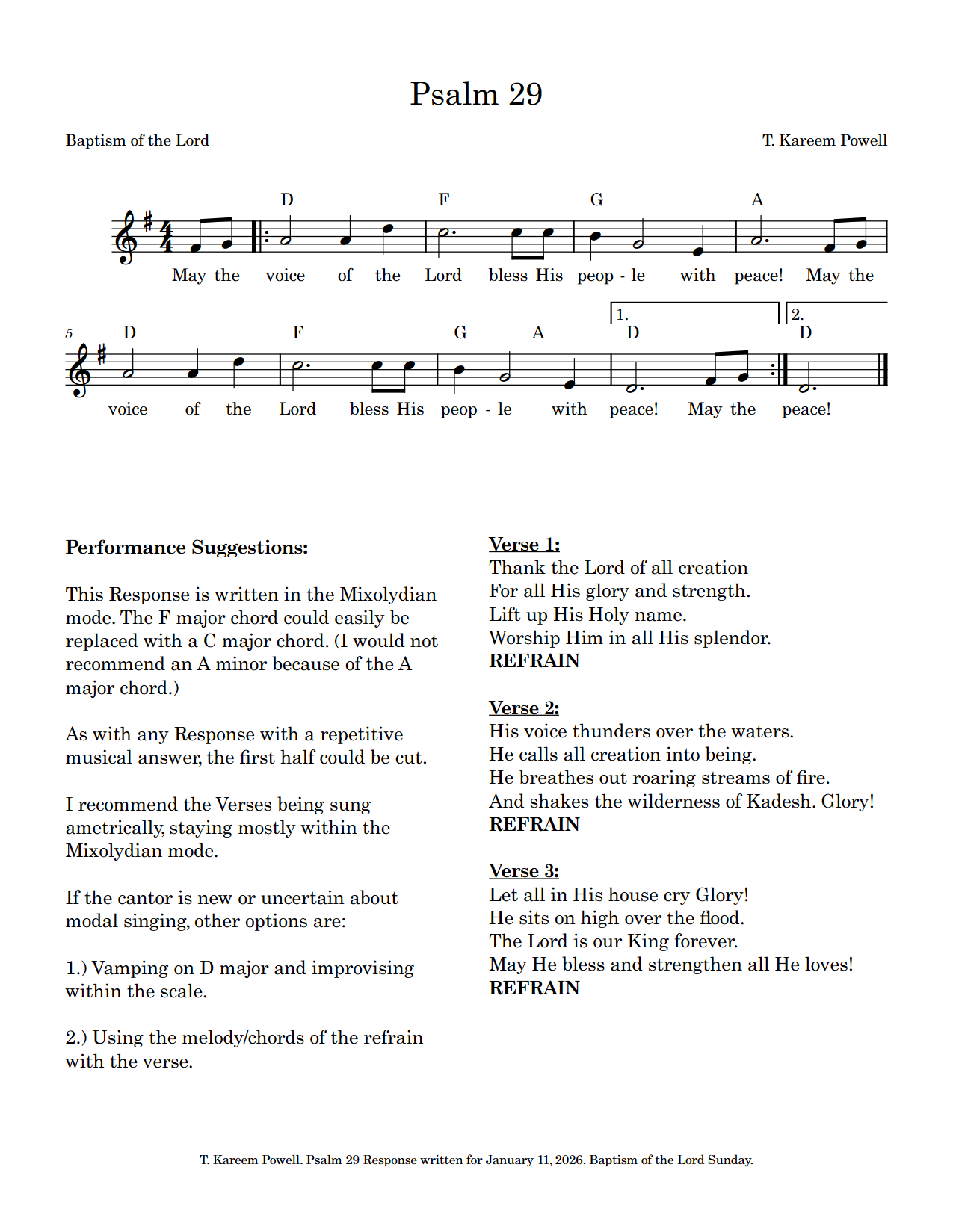 The key signature may be 1 Sharp, but rest assured that the Psalm response is not in G Major. It is in the Mixolydian mode, which you will often find in folk music, be it Appalachian or its ancestor across the ocean.
As with every entry, feel free to adopt, adapt, or discard as you wish. My own views may change as the year goes by.
No Comments