January 18, 2026 – Second Sunday after Epiphany
Revised Common Lectionary Readings:
Isaiah 49:1-7
Psalm 40:1-11
1 Corinthians 1:1-9
John 1:29-42
Our main job as ministers of the Gospel is to point to Jesus. Everything that we do – preaching, texts, song selection, Bible Study, outreach, etc. – is in service of that obligation. Liturgy is literally “work of the people.” Though it can be a bit hard to define, I look at it in terms of its purpose: “work of the people in coming to Jesus.”
The “order of worship” – particularly in a traditional service or mass – is typically what people mean when they say “liturgy.” It gets to the point, though I think that definition is unfair in the context of a contemporary service. If it is a worship service, it is liturgical. Yes, even that service by St. Mega Man with the lasers and the fog machine that blows during the offering is liturgical. Dismissing the formal structures of traditional liturgy does not make what replaces it any less “liturgical.” It just means it is a different “context” of liturgy.
I liken the “traditional vs. contemporary” designation much like “classical vs. jazz” music. They are two dialects of the same language with all sorts of mixture, interactions, and crossover in between. (Yes, they do borrow from each other.) This is not even getting into the cultural innovations that shape and influence them. Worship and liturgy are alive with the Breath of the God who inspires both.
God did not make everyone, everything, or every place the same. He did not make everyone, everything, and every place the same as they were ten minutes ago! That’s one of the reasons it is important to understand what liturgy is and its role in the life of the church.
In an earlier entry, I referenced the Wesleyan Quadrilateral – Scripture, Reason, Tradition, and Experience. There are people better suited to explain it – and some faith traditions disagree or consider different routes – but these are essentially ways that we come to understand faith.
We can tell “a” story of Jesus in 5-10 minutes, as we do every time we come to the communion table. It is going to be a different story than can be told in thirty minutes. Or an hour. Or a season. Or a year. Or three years. Or a lifetime. The lectionary is one way we tell the story over a three year cycle. The liturgical calendar with all the celebrations – Advent, Christmas, Epiphany, Easter, Pentecost, All Saints Day, etc. – is one way the story is told over the year. There are layers to it.
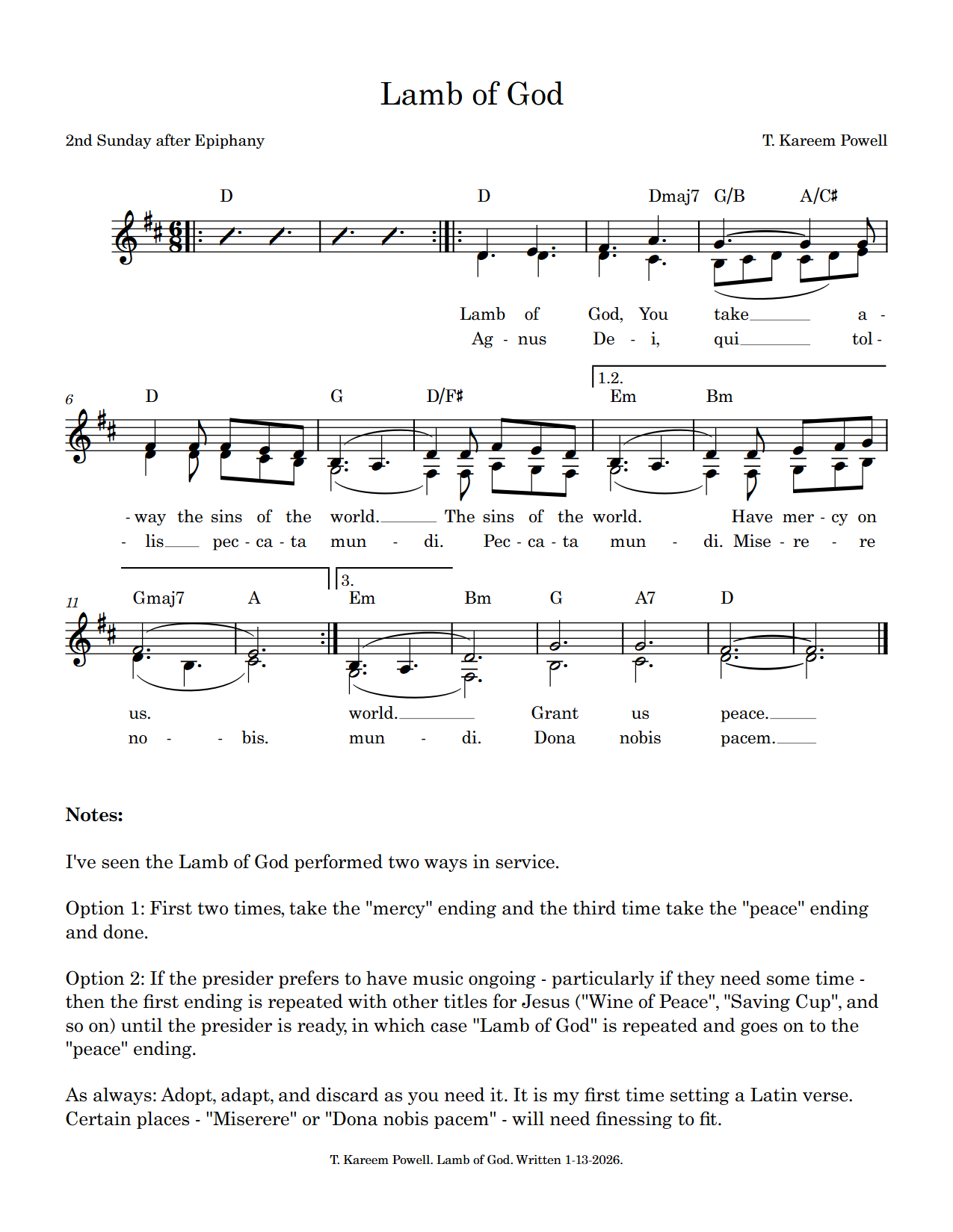
This week, I was inspired by the Gospel reading John 1:29-42. In it, John the Baptist sees Jesus and declares Him as the “Lamb of God who takes away the sin of the world.” (Yes, of course there is more.) This also happens to be the words to the Agnus Dei – aka Lamb of God – which (in a traditional service) is sung just before Communion is distributed.
Instead of a psalm response, I decided to write a Lamb of God.
As always: adopt, adapt, or discard at your leisure.
No Comments