Writer’s Note: This entry was originally posted on December 30, 2025. (I have been trying to post at least a week before the Lectionary Date.) For some reason, when my website updated to WordPress 6.9, it deleted this entry as well as the one for January 11. I did not find this out until I was about to put up my entry for January 18. It was a big mess that has set me behind on this project. Anyway… Things happen. This project is more about “reclaiming my space” – both this website and my liturgical background – than it is about getting everything out on time. It is also helpful in getting me to practice some writing and working on content. Much love and – as always – adopt, adapt, and discard at your liesure.
January 6, 2026 – The Feast of the Epiphany
Isaiah 60:1-6
Psalm 72:1-7, 10-14
Ephesians 3:1-12
Matthew 2:1-12
Even if you had not gotten to the Matthew reading yet, Isaiah and Psalm 72 should have you screaming “We Three Kings.” One thing I love about this song is that it embodies liturgy as “the work of the people.” Our faith is divinely inspired (otherwise it would not be faith). God uses a number of ways to shape it such as Scripture, tradition, reason, and experience.
Yes, I just used the Wesleyan Quadrilateral. Lutherans may feel free to direct all hate mail to sunstrikellc@gmail.com. (I’m joking! I think…)
If we relied solely on Scripture, we would never sing that song. Matthew does not say that the magi number three nor that they lead nations. The arrival at “three kings” – much less the names Caspar, Melchior, and my dude Balthazar – came about much later. Yet, these figures had such an impact on the story of Jesus and the unfolding of faith that they have been venerated as saints. These magi – regardless of how many there really are, their actual names, their royal status, or even the lands they came from – have staying power because they represent rulers – powerful people in this world – subordinating themselves to 1.) an infant, 2.) conceived (albeit by the Holy Spirit) out of wedlock, 3.) the (presumed) son of a builder, 4.) in an occupied land, and 5.) among an oppressed minority.
Baby Jesus both had ultimate power and yet at the same time no power. These wise men – who were so esteemed that Herod kissed up to them – sought Him out and bowed down to Him.
Yes. Epiphany is actually a pretty big deal, which the rest of the world already knows and yet here in the United States, we go “Oh… That’s cool.” I have more thoughts, but I’ll save those for another day.
To be clear, Epiphany is not just about the Wise Men. It is about the revelation of Jesus as the Christ: the Wise Men, Jesus’s Baptism, and the miracle of the Wedding at Cana. Ask your pastor about those; this article is already getting long!
There are a number of liturgical possibilities in these readings. Isaiah screams to me “Call to Worship.”
One possibility for the Psalm Response is to simply take the refrain from “We Three Kings.” (“Star of wonder, star of light…”) People generally already know it and it points to the Lord. The refrain that I am presenting is definitely inspired by “We Three Kings.”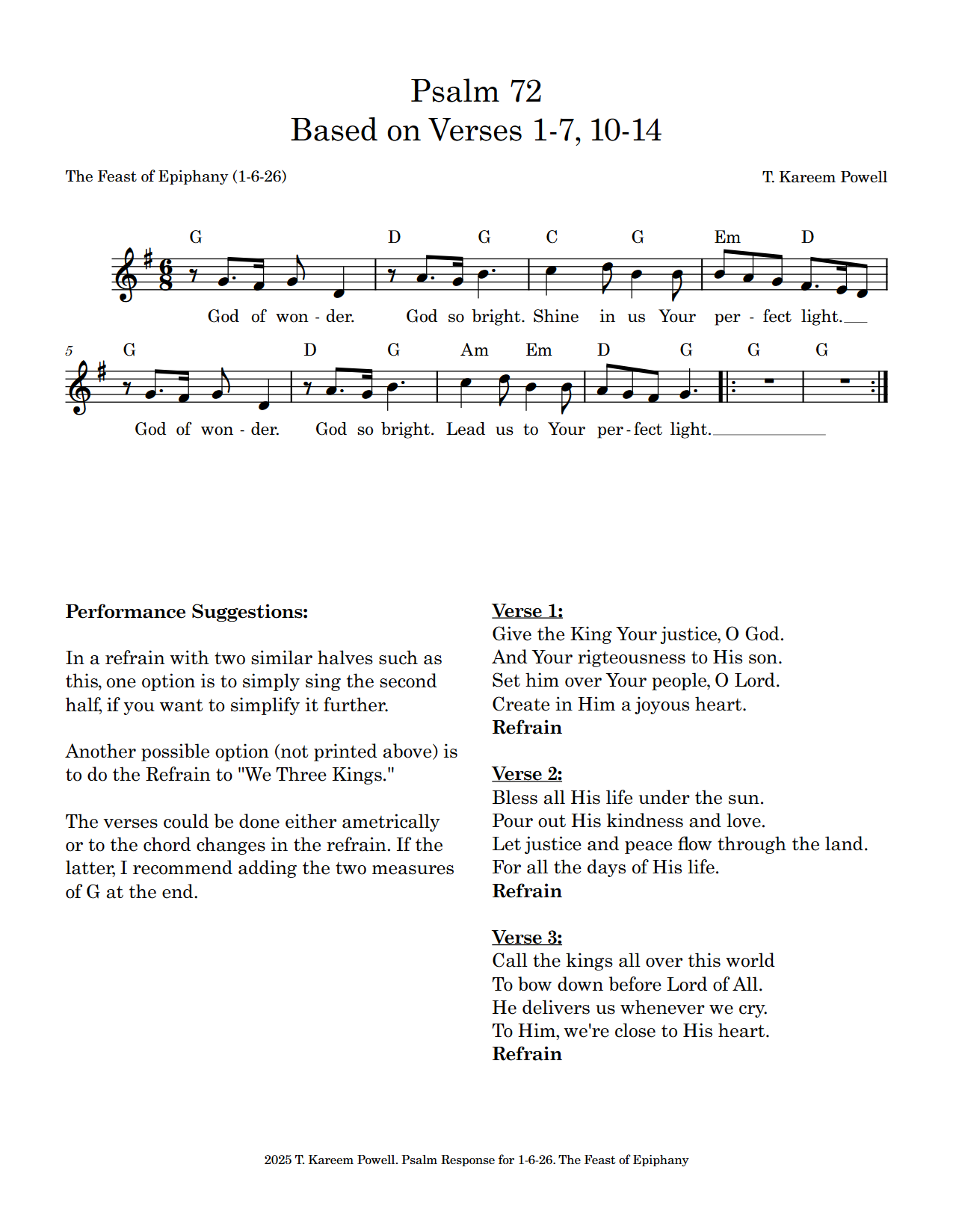 The purpose of liturgy – and anything we do – is to point in some way to the Holy Trinity. The Three Kings of Christian tradition do not strictly adhere to Scripture, but we cannot deny that they point to Jesus. They sought Him out. They brought offerings to Him. They bowed down to Him. They recognized Him as Lord. We as the Church are supposed to do all those very things.
Happy Epiphany!
No Comments